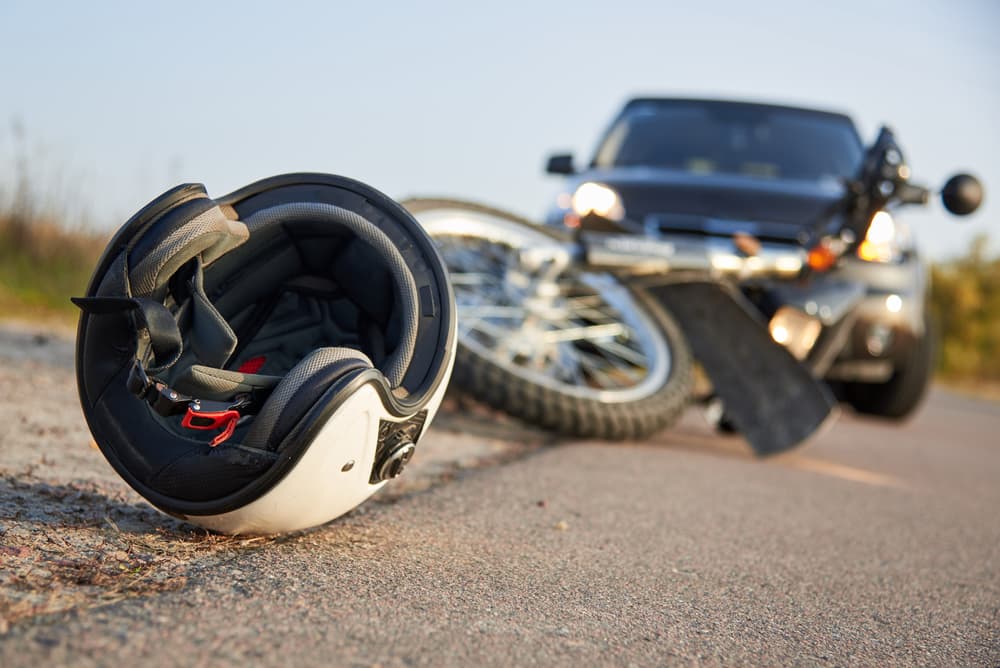
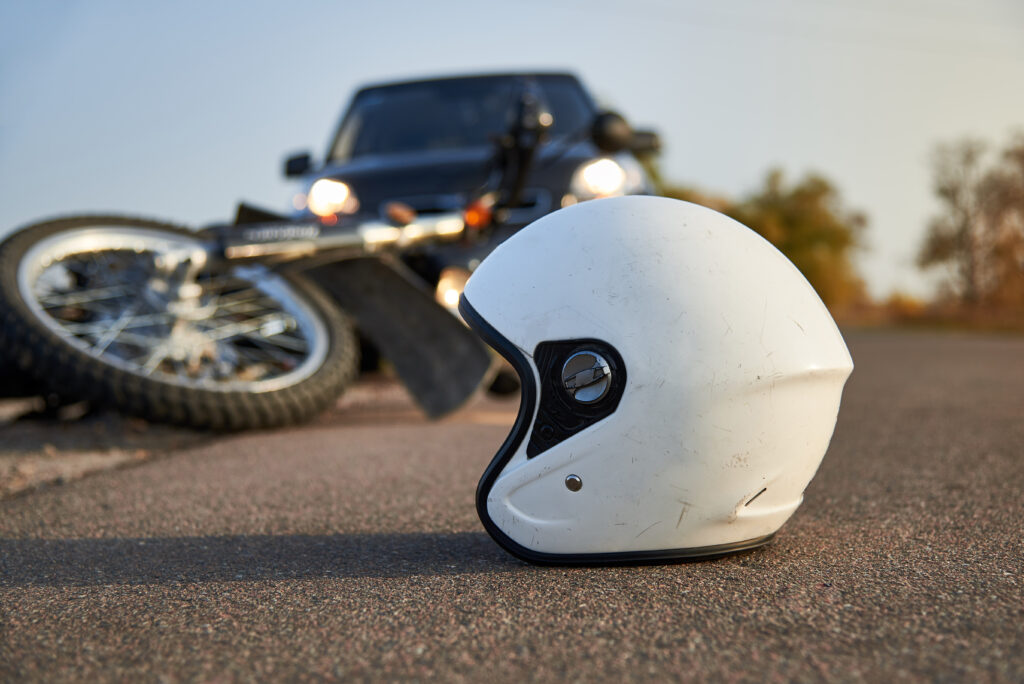
New Jersey motorcycle helmet laws require motorcycle operators and passengers to wear approved protective helmets, regardless of age or riding experience. If you are wondering, do you need a helmet in NJ, the answer is yes in nearly every situation covered by the state motorcycle helmet statute. The law also addresses helmet construction, fit, straps, reflective material, and related eye-protection requirements.
New Jersey riders should understand these rules before crossing state lines, particularly when traveling between Hackensack, Jersey City, Newark, and neighboring New York or Pennsylvania. The requirements change once a rider enters another state. At Reinartz Law Firm, we handle motorcycle injury claims across Bergen County and northern New Jersey, and helmet questions come up in almost every one.
Key Takeaways
- New Jersey requires motorcycle operators and passengers to wear approved protective helmets, with no age-based or experience-based exemption under the state helmet statute.
- Motorcycle operators generally must use approved goggles or a face shield unless the motorcycle has an approved windscreen.
- A violation can result in a fine, but New Jersey does not assess motor vehicle points for failing to wear a motorcycle helmet.
- Helmet nonuse can become relevant to an injury claim when evidence connects the absence of a helmet to the severity of particular injuries.
- New York also has a universal helmet requirement, while Pennsylvania permits certain riders age 21 or older to ride without a helmet if they satisfy specified experience or training requirements.
What Does New Jersey’s Motorcycle Helmet Law Require?
New Jersey’s universal motorcycle helmet law requires every person operating or riding on a motorcycle to wear a securely fitted protective helmet of the proper size and an approved type. N.J.S.A. 39:3-76.7 establishes the basic requirement and also requires the helmet to have either a neck or chin strap and reflectorized material on both sides.
The statute carves out completely enclosed autocycles and three-wheeled vehicles with an enclosed cab, automotive seating, seat belts, and standard steering.
A qualifying helmet must meet Federal Motor Vehicle Safety Standard 218, the federal performance standard covering impact absorption, penetration resistance, and retention system strength. That standard is more than a recommendation in New Jersey. The Motor Vehicle Commission adopted and incorporated it by reference at N.J.A.C. 13:20-24.10, which is how the statute's reference to an approved type gets its content.
Novelty helmets that do not meet the standard, sometimes sold as shorty or costume-style helmets, do not satisfy New Jersey's requirement even when they resemble an approved helmet. A compliant helmet typically carries a DOT label.
New Jersey also requires eye protection. Under N.J.S.A. 39:3-76.8, a motorcycle operator must wear approved goggles or a face shield. The requirement runs to the operator and not to passengers, which surprises many riders.
The New Jersey Motorcycle Manual describes goggles and a face shield as protection against wind, debris, insects, and other objects that can interfere with vision. Riders taking the state road test must bring both a helmet and eye protection.
An approved windscreen removes the separate requirement to wear goggles or a face shield under N.J.S.A. 39:3-76.9. The exception is tied to an approved windscreen meeting state specifications, so the equipment actually mounted on the motorcycle decides the question, and no rider should assume an aftermarket screen qualifies.
How Does New Jersey Compare With New York and Pennsylvania?
The motorcycle helmet law New Jersey riders follow is stricter than Pennsylvania's for certain adult riders, while New York matches it. A person who legally rides without a helmet in Pennsylvania may still violate New Jersey law after crossing the state line.
New York enforces a universal helmet requirement under New York Vehicle and Traffic Law Section 381, with no exception for age or experience. The statute writes FMVSS 218 directly into its text rather than adopting it by regulation, as New Jersey does. A New Jersey commuter riding into New York follows essentially the same rule they already follow at home.
Pennsylvania takes a different approach. 75 Pa. C.S. Section 3525 exempts riders age 21 and older from the headgear requirement if they have held a motorcycle license for at least two full calendar years or have completed an approved motorcycle safety course. A passenger age 21 or older riding with an exempt operator is covered as well.
One detail gets missed often. Pennsylvania's exemption reaches headgear only, so the eye protection requirement in the same statute still applies with no age exemption. A New Jersey rider crossing the state line does not automatically gain the headgear exemption either, because it turns on that rider's own license history or training.
How Can Helmet Use Affect a Motorcycle Injury Claim?
Helmet use can matter to an injury claim, but not in the way many riders assume. New Jersey law does not bar recovery because a rider was not wearing a helmet. The question is narrower, and it is whether the absence of a helmet affected the severity of the specific losses being claimed.
New Jersey's approach comes from seat belt law rather than helmet law. In Waterson v. General Motors Corp., the New Jersey Supreme Court held that a defendant raising nonuse of a seat belt must show the device was available, that the plaintiff was unreasonable in not using it, and that the nonuse increased the severity of the injury. Only then does nonuse affect damages at all.
The state's model civil jury charge on seat belt nonuse then divides damages into two groups. Losses that would have occurred regardless of the seat belt are reduced only by the plaintiff's share of fault for the crash itself. The separate group of losses traced to nonuse is reduced by the plaintiff's combined share of fault for both the crash and the nonuse.
That framework has a limit worth knowing. No published New Jersey appellate decision has applied it to motorcycle helmets, so an insurer raising a helmet argument is extending a seat belt rule rather than citing settled helmet law. That distinction is worth pressing rather than conceding.
The underlying fault rule is modified comparative negligence, which means an injured person's recovery is reduced by their own share of fault and is barred only if that share is greater than the combined fault of the parties they are suing. It is codified at N.J.S.A. 2A:15-5.1. A rider found 50 percent at fault still recovers, with the award cut in half.
An insurer may still argue that a missing helmet increased the severity of a claim and ask that a percentage be assigned on that basis. That argument goes to the size of the damages, not to who caused the collision. We treat those as two separate questions, because New Jersey law treats them separately.
Motorcycle Safety: Reducing the Risk of a Crash
Helmet compliance is one part of motorcycle safety, but riders also face risks from traffic, roadway conditions, and other drivers. Understanding the common causes of NJ motorcycle accidents can help riders recognize situations that may require additional caution.
- Distracted Driving: A distracted motorist may fail to notice a motorcycle while changing lanes, turning, or entering an intersection.
- Inexperience: Drivers with limited experience around motorcycles may misjudge a rider's position, speed, or distance.
- Speeding: Higher speeds cut the time available to react and increase the force involved in a collision.
- Left-Turn Crashes: A vehicle turning left may cross the path of an approaching motorcycle at an intersection, driveway, or parking area.
- Blind-Spot Collisions: Motorcycles are harder for drivers to see in certain areas around a vehicle, particularly during lane changes.
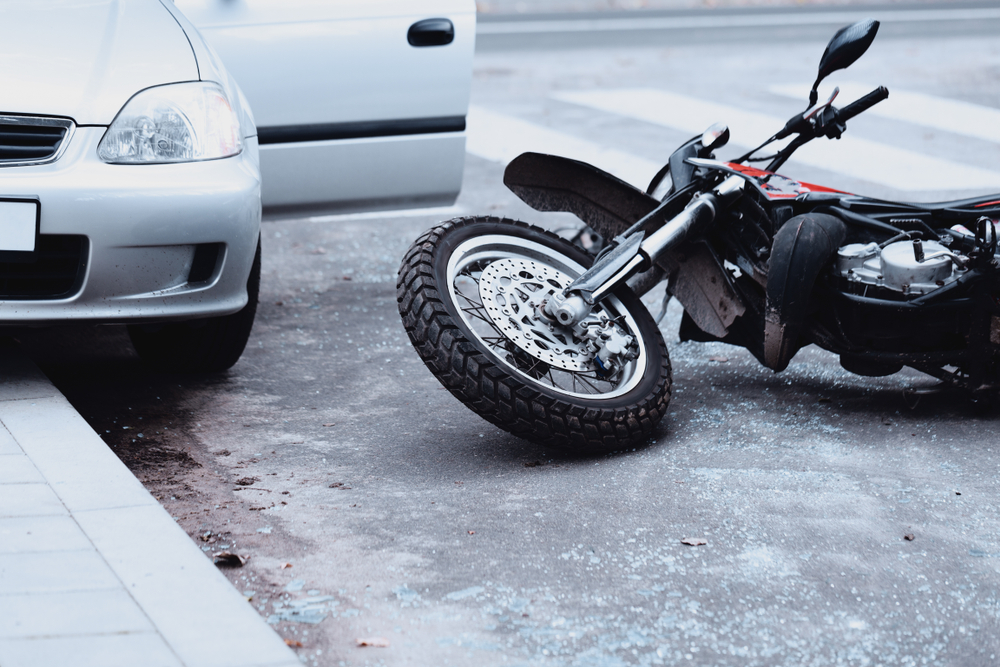
- Doorings and Roadway Hazards: An opened vehicle door, debris, uneven pavement, oil, and railroad tracks all create hazards specific to two wheels.
Jersey City motorcycle riders should know that dense intersections, frequent lane changes, and heavy street parking create additional challenges in urban traffic.
None of this eliminates the possibility of a crash, but helmet compliance and eye protection are the parts a rider controls. We see how often a claim turns on what a rider could reasonably have done in the seconds before impact.
What Are the Penalties for Riding Without a Helmet in New Jersey?
A helmet violation in New Jersey is a fine-only offense with no license points. N.J.S.A. 39:3-76.7 states that the chief administrator shall not assess motor vehicle points for failing to wear a protective helmet. That is unusual among moving violations.
The fine itself is modest. N.J.S.A. 39:3-79 sets a ceiling of $25 for violations in this article of the motor vehicle code, and it is a maximum rather than a fixed first-offense amount. Riders should confirm the current figure against the Statewide Violations Bureau Schedule, because scheduled fines and court costs change.
A separate provision governs passengers. N.J.S.A. 39:3-76.5 requires a passenger to wear a properly fitted helmet and sets a fine of $50 to $100 for an operator who carries a passenger in violation of that section's requirements. The two provisions are frequently blurred together, and they are not the same offense.
The absence of points does not make a citation meaningless. It sits in the record if a crash follows and shapes how an insurer frames a claim, which is why we look at citation history early.
Choosing a Helmet That Meets New Jersey Requirements
A helmet meets New Jersey's requirement only if it is an approved type, securely fitted, and the proper size for the rider. It must also carry a neck or chin strap and reflectorized material on both sides. The New Jersey Office of the Attorney General publishes those same requirements on its motorcycle safety page.
The New Jersey Motorcycle Manual instructs riders to look for the DOT symbol on the outside back of the helmet, which indicates compliance with FMVSS 218. Helmets sold as novelty or costume items often resemble approved helmets without meeting the standard. Appearance alone tells a rider nothing about compliance.
Condition matters as much as certification. Damage, deterioration, or a poor fit can affect whether a helmet performs as designed, even when the original model met the standard. We tell clients to replace a helmet after any impact.
FAQs: New Jersey Motorcycle Helmet Laws
These questions address additional issues that riders may encounter when applying New Jersey motorcycle helmet laws.
Can I wear a half helmet in New Jersey?
A helmet's appearance does not determine whether it complies with New Jersey law. The helmet must be of an approved type and satisfy the applicable requirements, including federal FMVSS 218 standards and the state's requirements concerning fit, fastening, and reflectorization.
Do passengers have to wear eye protection in New Jersey?
New Jersey's eye protection requirement under N.J.S.A. 39:3-76.8 applies to the operator of a motorcycle, not to passengers. The helmet requirement is different and covers operators and passengers alike. A passenger without goggles or a face shield is not violating the eye protection statute, though eye protection is still worth wearing.
What if my helmet meets an out-of-state standard but not New Jersey's?
There is no such thing. FMVSS 218 is a single national standard, so a helmet that is DOT compliant in another state is compliant here, and one that is not was never compliant anywhere.
Can a helmet citation be used against me even if I wasn't in an accident?
A standalone helmet citation is treated as a traffic violation with a fine and no points, separate from any accident. However, it only becomes relevant to an injury claim if a crash happens and injuries are involved.
Do New Jersey's helmet laws apply on private property?
New Jersey's motorcycle statutes generally apply to operation on public roads and highways. Private property use can fall into a gray area, so riders should check local rules if they plan to ride somewhere other than public streets.
Talk to a New Jersey Motorcycle Accident Lawyer

New Jersey's helmet rules are straightforward, but the legal questions that follow a motorcycle collision rarely are. Helmet compliance, injury severity, insurance coverage, and responsibility for the crash all turn on the specific facts and the evidence available. We can talk through what happened and what your claim may involve, so call Reinartz Law Firm at 201-289-8614.