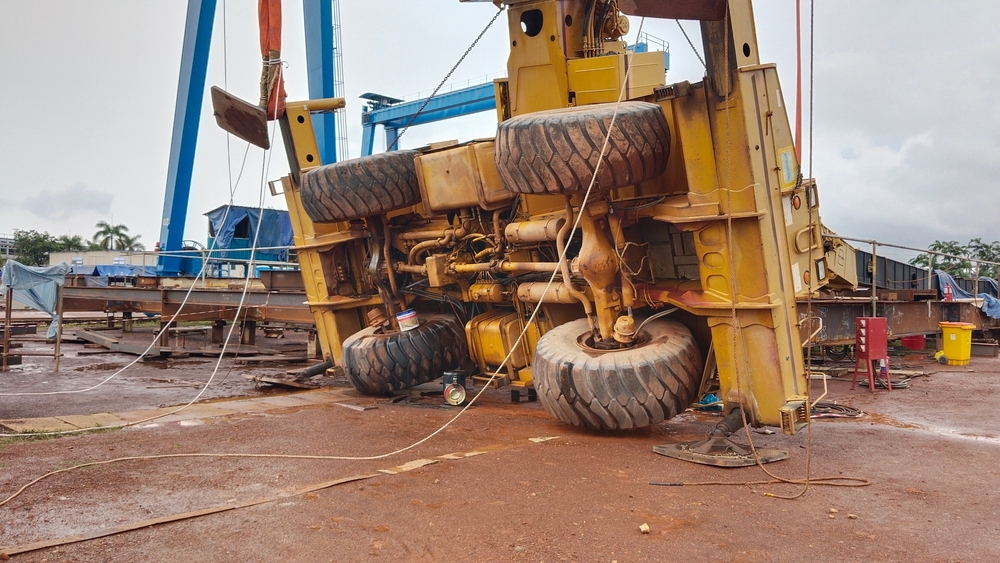

The construction sites pushing up along Route 17, the rail corridor redevelopments in Hudson County, and the warehouse expansions spreading across Bergen County all run on heavy machinery. And that machinery injures workers at a rate that rarely makes the news.
When a crane operator in Hackensack gets struck by a swinging load, or a factory worker in Lodi gets caught between a forklift and a loading dock, the workers' compensation system is supposed to activate. But the path from injury to full benefit recovery is rarely automatic, particularly when heavy equipment is involved, and multiple parties share responsibility.
Key Takeaways
- Heavy machinery accidents in New Jersey construction and factory settings fall under OSHA's "Fatal Four" categories: falls, struck-by incidents, caught-in/between hazards, and electrocution, with caught-in/between machinery events accounting for roughly 7% of construction fatalities nationally.
- New Jersey's workers' compensation system covers heavy machinery injuries on a no-fault basis under N.J.S.A. 34:15-1 et seq., meaning the injured worker does not need to prove the employer was negligent to receive medical and disability benefits.
- When a subcontractor, equipment manufacturer, or property owner contributed to the accident, a separate civil lawsuit under N.J.S.A. 34:15-40 can run alongside the workers' comp claim, allowing recovery for pain and suffering and lost earnings that workers' comp does not address.
- The workers' comp carrier that pays benefits holds a statutory lien against any third-party recovery, but that lien is subject to reduction for attorney fees and litigation costs under N.J.S.A. 34:15-40.
- Attorney fees in New Jersey workers' compensation cases are capped at 25% under the amended N.J.S.A. 34:15-64, effective August 22, 2024.
The Construction Site Problem in Northern New Jersey
Bergen County and the surrounding region are in an infrastructure cycle. Road widening on Routes 4 and 46, mixed-use redevelopments in Hackensack's downtown corridor, and ongoing utility work throughout the county keep construction crews active year-round on tight schedules.
Schedule pressure is the single most predictable contributor to heavy machinery accidents. When a project runs behind, safety protocols get skipped. Crane pre-lift inspection checklists get abbreviated. Spotters get pulled off to handle other tasks. Excavator operators work with obstructed sightlines. None of this is theoretical. It describes how most caught-in/between and struck-by accidents actually originate.
What categories of heavy machinery most commonly injure New Jersey construction and factory workers?
The equipment that produces the most severe injuries in New Jersey's construction and manufacturing environments includes:
- Cranes and hoists, where dropped loads and swinging booms cause struck-by injuries
- Forklifts and telehandlers, where tip-overs, pedestrian collisions, and pinning events are the primary mechanisms
- Excavators and backhoes, where caught-in/between accidents occur during trenching and grading
- Concrete mixers and pump trucks, where rotating components and high-pressure systems create separate hazard categories
- Industrial presses, rollers, and stamping equipment, where contact with moving parts during operation or maintenance causes crush and amputation injuries
Each machine type carries its own OSHA standard, its own inspection requirement, and its own operator training rules. When those requirements fail, the resulting injury is rarely the first warning sign.
Why does heavy machinery make workers' comp claims more complex?
Speed is one reason. Heavy machinery accidents tend to produce catastrophic injuries, including amputations and other serious harm that generate high medical costs and significant long-term disability. Carriers respond with greater scrutiny, independent medical examinations, and challenges to both treatment and disability.
Multi-party jobsites add a second layer. A construction worker employed by a subcontractor may get injured because of a crane operated by a different subcontractor, on a site owned by a general contractor, using a machine manufactured by a third company. Workers' comp covers the direct employment relationship. It does not prevent the injured worker from pursuing the other parties in civil court.
Workers' Comp Coverage for Heavy Machinery Injuries
New Jersey's workers' compensation system operates on no-fault principles. An injured worker does not need to show that the employer cut corners or ignored safety rules to receive benefits. The question is simply whether the injury arose out of and in the course of employment.
What benefits does a New Jersey worker injured by heavy machinery qualify for?
The benefits available under New Jersey workers' compensation for a heavy machinery injury include:
- All authorized medical treatment, including emergency care, surgery, hospitalization, rehabilitation, and prosthetics
- Temporary disability benefits at 70% of the worker's average weekly wage, subject to the state maximum of $1,159 per week for 2025 injuries (or $1,199 per week for injuries occurring in 2026)
- Permanent partial disability benefits if the injury leaves measurable, lasting functional limitations, calculated under N.J.S.A. 34:15-12
- Permanent total disability benefits if the worker cannot return to any gainful employment
- Specific loss benefits for amputations or permanent loss of use of a scheduled body part
- Death benefits for the dependents of workers killed in heavy machinery accidents under N.J.S.A. 34:15-13
What happens when the employer disputes that the machinery accident was work-related?
Disputes are heard before a judge of compensation in the New Jersey Division of Workers’ Compensation, with Bergen County cases typically handled in Hackensack. These proceedings are streamlined and focus on medical records, wage history, and medical evaluations.
Unlike civil lawsuits, depositions are rarely used. Instead, cases rely on OSHA reports, employer investigations, witness statements, equipment maintenance logs, and emergency room records. Attorneys build this evidentiary record early, anticipating that insurers will closely review the same documentation throughout the claim process.
When Workers' Comp Is Only Part of the Picture
Workers' compensation covers the employer. It does not cover everyone whose negligence contributed to the accident.
Who are the third parties that can face civil liability after a construction machinery accident?
On a multi-party construction site or in a factory setting where equipment came from an outside source, potentially liable third parties often include:
- A general contractor or project owner whose site management created the dangerous condition
- A subcontractor whose equipment, employees, or work practices caused the incident
- A crane rental company that provided defective or improperly maintained equipment
- A forklift or heavy machinery manufacturer whose design or manufacturing defect contributed to the injury
- A property owner whose premises created the hazard that the machinery operator encountered
Under N.J.S.A. 34:15-40, the injured worker can pursue a civil lawsuit against any of these parties without forfeiting workers' comp benefits. In contrast to workers' comp, a Superior Court judgment or settlement can include pain and suffering damages, full future lost earnings, and loss of enjoyment of life. New Jersey does not cap non-economic damages in personal injury cases, so for severe machinery injuries, these figures can be substantial.
Steps That Protect a Heavy Machinery Injury Claim
The decisions made in the first days after a heavy machinery accident have outsized consequences on the claim's outcome.
Many injured workers and their families find it useful to:
- Report the injury to the employer in writing the same day, even if emergency treatment takes priority
- Request preservation of any video footage from the site or facility, since many construction sites and factory floors maintain camera systems that record equipment operations
- Ask whether OSHA was notified, since private-sector employers must report hospitalizations and amputations within 24 hours under federal requirements
- Avoid providing a recorded statement to the employer's insurance adjuster without first speaking with a New Jersey workers' compensation attorney
- Request all incident investigation documents that the employer prepared, which must be produced in the Division of Workers' Compensation proceedings
The third-party question deserves early attention. If a subcontractor, equipment owner, or manufacturer may share responsibility, the window for preserving physical evidence and identifying witnesses is short. Waiting until the workers' comp claim resolves to evaluate civil options allows critical evidence to disappear.
Ask Richard Reinartz
I work for a subcontractor. The crane that hit me is owned by the general contractor. Can I sue them?
Yes. Workers' compensation covers the direct employer. The general contractor who owned and operated the crane is a third party under N.J.S.A. 34:15-40, and you can pursue a civil negligence claim in New Jersey Superior Court while your workers' comp case proceeds.
Your workers' comp carrier will assert a lien against any civil recovery, but that lien is subject to reduction for litigation costs, and the net result of running both cases is almost always significantly higher than workers' comp alone.
The company I work for says the accident was my fault because I was in a restricted zone. Does that bar my workers' comp claim?
No. New Jersey's workers' compensation system is no-fault. Employee negligence does not bar a claim or reduce benefits owed under N.J.S.A. 34:15-1 et seq. Your employer's carrier may raise fault as a pressure tactic, but it carries no legal weight inside the Division of Workers' Compensation.
Heavy Machinery Workers' Comp FAQ: Answers From Our Hackensack Attorneys
Does workers' comp cover a traumatic brain injury from a construction machinery accident in New Jersey?
A traumatic brain injury is compensable under New Jersey workers' compensation when caused by a work-related accident, and coverage includes the related medical care and rehabilitation. Permanent disability from this kind of injury is evaluated on functional limitations rather than a scheduled loss, and a judge of compensation assesses the overall disability.
These claims are among the most heavily disputed in workers' comp. The carrier will typically commission a neurological evaluation, and the petitioner's attorney counters with testimony from the treating team and any independent specialists retained for the Division proceedings.
Can a worker file workers' comp if injured by heavy machinery operated by a co-worker?
Yes. The no-fault nature of New Jersey's workers' compensation system means the source of the negligence does not affect the employer's obligation to provide benefits. Whether the injury resulted from equipment failure, a supervisor's decision, or a co-worker's error, the claim is compensable as long as it arose from employment.
The exception is intentional conduct reaching the level of an intentional wrong under the Laidlaw doctrine, which permits a civil suit against the employer only when the employer knew injury was substantially certain to occur. Standard construction site negligence does not reach that threshold.
What is the process for disputing a workers' comp carrier's denial of surgery after a heavy machinery injury?
When a carrier denies authorization for surgery, the worker's attorney files a motion for medical benefits before a judge of compensation. The judge reviews the treating physician's recommendation and the carrier's IME report and determines whether the treatment is causally related to the work injury and medically necessary.
These motions typically resolve faster than full claim petitions because they address a discrete issue. Prevailing also allows the judge to award attorney fees under N.J.S.A. 34:15-64 against the carrier that forced the motion.
What happens to workers' comp benefits if a third-party civil settlement is reached before the workers' comp case closes?
Under N.J.S.A. 34:15-40, the workers' compensation attorney must advise the judge of compensation of any third-party recovery before the workers' comp case resolves. The carrier's lien is calculated based on total benefits paid as of the recovery date.
After the lien is satisfied, workers' comp benefits may continue depending on what ongoing disability and medical treatment remain. Coordination between the attorneys handling both matters is essential, since a third-party settlement that fails to account for the lien can reduce the worker's net recovery significantly.
Getting the Full Answer on Your Claim
Heavy machinery accidents are among the most serious workplace injuries we handle at Reinartz Law Firm. Workers' comp provides a foundation, but it rarely captures the full scope of what a worker loses when a crane, forklift, or industrial press puts them in the hospital.
We represent injured construction and factory workers throughout New Jersey from our Hackensack office at 21 Main Street, Suite 205. Richard Reinartz evaluates both the workers' compensation track and any civil claims against third parties from the first consultation, including equipment manufacturers, general contractors, and negligent subcontractors.
There are no upfront legal fees, and attorney fees in workers' comp matters are capped at 25% under N.J.S.A. 34:15-64 as of August 2024. Call us at (201) 778-HURT or contact us online to go over the facts of your accident and what your options look like across both legal tracks.