
Quick Answer: If a defective machine hurt you on the job in New Jersey, workers' compensation is rarely the end of the story. You may also have a separate third-party claim against the company that designed, built, sold, leased, or maintained that machine.
- Workers' comp pays medical bills and a portion of lost wages, but it does not pay for pain and suffering
- A third-party product liability claim can recover those broader damages
- The two cases run side by side, and you do not have to choose between them
- New Jersey's Product Liability Act sets the rules for proving a machine was defective
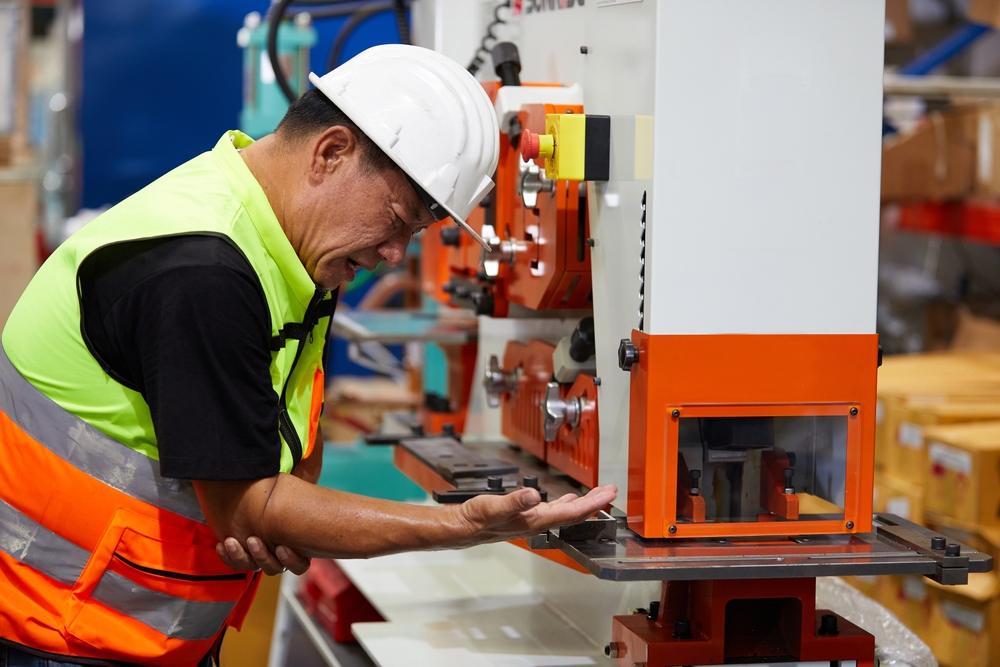
A workplace injury caused by a press, saw, conveyor, forklift, or other piece of industrial equipment can be devastating. One moment you are doing your job, and the next you are looking at surgery, time away from work, and a pile of bills.
If the machine that hurt you was unsafe by design, poorly built, missing proper guards, or sold without adequate warnings, defective machine injuries can open the door to a third-party claim in New Jersey that goes well beyond what workers' compensation alone provides.
Key Takeaways about Defective Machine Injury Claims
- Injured workers in New Jersey generally cannot sue their employer for a workplace injury, but they can sue outside companies whose negligence or defective products caused harm
- Defective machine cases fall under the New Jersey Product Liability Act, which recognizes design defects, manufacturing defects, and failure-to-warn defects
- Manufacturers, distributors, sellers, rental companies, and outside maintenance contractors can all potentially be held responsible
- Workers' compensation benefits and a third-party recovery can be pursued at the same time, though the comp insurer may seek partial reimbursement from any third-party recovery
- Most product liability claims in New Jersey must be filed within two years of the injury
Why Workers' Comp Alone Often Falls Short
When you get hurt on the job in New Jersey, workers' compensation steps in quickly. It pays for authorized medical treatment, a portion of your lost wages while you recover, and a permanency award at the end of the case if your injury qualifies.
You do not have to prove anyone was at fault to receive these benefits.
The trade-off is that workers' comp does not cover everything. Under New Jersey law, an injured employee usually cannot sue their employer for an ordinary workplace accident, even when the employer was careless.
Comp benefits are the exclusive remedy against the employer in most situations. That exclusivity has real consequences for someone with a serious machine injury:
- No payment for pain and suffering
- No compensation for emotional distress
- Limited recovery for future lost earning capacity
- No punitive damages, even when conduct was reckless
- A loss of consortium claim by your spouse is not available through comp
When the injury is severe, comp benefits may cover only a fraction of the true loss. That is where a third-party claim becomes important.
What a Third-Party Claim Means in New Jersey
A third-party claim is a separate civil lawsuit against someone other than your employer or a co-worker. New Jersey law specifically preserves this right.
Under N.J.S.A. 34:15-40, receiving workers' compensation does not block you from suing an outside party whose negligence or defective product contributed to your harm.
A third-party case operates under regular personal injury and product liability rules, not under the comp system. That means the damages you can recover are much broader, and a jury can hear your full story rather than apply a fixed statutory formula.
When a machine causes the injury, the third-party claim is usually a product liability case, governed by the New Jersey Product Liability Act at N.J.S.A. 2A:58C-1 and following. The Act sets out exactly what an injured person must prove and who can be held responsible.
How New Jersey Defines a Defective Machine
Not every machine that causes an injury is legally defective. The law focuses on whether the equipment was reasonably fit, suitable, and safe for its intended purpose.
New Jersey recognizes three main types of defects, and a machine injury case can involve any one of them, or a combination.
Manufacturing Defects
A manufacturing defect exists when an individual machine, or a particular component, comes off the assembly line in a way that does not match the manufacturer's own design or specifications.
The design itself may be perfectly safe, but the unit that hurt you was built wrong. A weld that did not hold, a bolt that was the wrong grade, or a circuit board that failed early can all point to a manufacturing defect.
Design Defects
A design defect means the entire line of machines is unsafe because of how it was designed, not because of a one-off mistake during assembly. Common examples include:
- Missing or inadequate point-of-operation guards on presses, saws, or grinders
- Pinch points and crush zones that should have been shielded
- Emergency stops that are difficult to reach during an actual emergency
- Two-hand controls that can be defeated with simple workarounds
- Lockout and tagout features that are easy to bypass
To prove a design defect, the case generally has to show there was a practical, technically feasible alternative design that would have prevented the harm without ruining how the machine functions. This is spelled out in N.J.S.A. 2A:58C-3.
New Jersey law gives extra weight to workplace machine cases here, and the "obvious danger" defense that sometimes helps manufacturers in consumer cases does not apply the same way to industrial machinery used in the workplace.
That distinction matters, because it gives injured workers a fairer chance to hold manufacturers accountable for unsafe equipment.
Failure to Warn
A failure-to-warn defect is about communication. The machine itself may function the way it was designed, but the manufacturer never told users about a hidden danger or never gave clear instructions on how to operate it safely.
Warning labels that are missing, faded, written only in technical jargon, or buried in a manual no one in the plant ever sees can all support this kind of claim.
Each defect theory comes with its own elements of proof, and many machine cases involve more than one.
Who Can Be Held Responsible in a Defective Machine Case
The "third party" in a third-party claim is anyone other than your employer who played a role in the injury. With machine cases, the list of possible defendants is often longer than people expect:
- Manufacturers that designed and built the machine or its components
- Component part makers whose specific part failed, even if the rest of the machine was fine
- Distributors and sellers in the chain of commerce
- Rental and leasing companies that supplied the equipment to your employer
- Refurbishers and rebuilders who restored older machines for resale
- Maintenance contractors hired from outside the company to service the machine
- Engineering firms that consulted on installation or modifications
Each potential defendant is evaluated separately. Sometimes the strongest claim is against the manufacturer, and sometimes the real problem was a sloppy maintenance contract or an aftermarket modification done by an outside vendor.
In Hackensack, Bergen County, and the industrial corridors near Route 17 and Route 4, machinery comes from suppliers across the country, which often expands the field of potential defendants for a worker hurt locally.
Why Pursuing Both Claims Matters
Workers' compensation and a third-party product liability claim are designed to work together. You do not have to pick one. Comp benefits can keep flowing while the product case is being built and litigated, which protects access to medical care during what is often a long road to recovery.
The damages a third-party case can pursue are far broader than comp:
- Past and future medical expenses not covered by comp
- Full lost wages and reduced future earning capacity
- Pain and suffering, including the day-to-day toll of the injury
- Emotional distress and impact on quality of life
- Loss of consortium for a spouse
- Punitive damages in cases of egregious conduct
There is one important rule to understand. When a third-party recovery comes in, the workers' comp insurer typically has a lien on part of that money under New Jersey's Section 40 framework.
The lien prevents double recovery for the same losses, but the statute also credits a portion of attorney's fees and costs against the lien. Negotiating that lien down is often a meaningful part of the final result.
How a Defective Machine Case Gets Built
Product liability cases against machine manufacturers are document-heavy and rely on careful technical analysis. The work usually starts with the equipment itself.
- Locking down the machine and any failed parts before anyone can repair, alter, or scrap them
- Photographing the scene, the guarding, the controls, and any warning labels
- Pulling the make, model, and serial number, plus any service records
- Identifying the manufacturer, distributor, and any rental or maintenance providers
- Reviewing OSHA reports and internal incident investigations
- Retaining qualified engineers to examine the machine and the alleged defect
- Looking for prior similar incidents, recalls, or service bulletins involving the same model
Federal workplace safety standards from OSHA on machine guarding often play a role. They do not by themselves prove a product defect, but they help frame what reasonable safety looked like at the time the machine was built and sold.
Strict deadlines apply, and evidence can disappear quickly if no one preserves it, so acting early protects the case.
FAQs about Defective Machine Injuries and Third-Party Claims in NJ
Below are answers to common questions about defective machine injuries and third-party claims in New Jersey that we hear from injured workers and their families.
Can I file a third-party claim if my employer modified the machine after buying it?
Maybe. Substantial alterations made by an employer after a sale can complicate a product case, but they do not automatically end it. The question is usually whether the modification was reasonably foreseeable to the manufacturer and whether the original defect still played a role in the injury.
What if the machine is older or no longer made?
Older equipment can still support a product liability claim. The key is preserving the machine and locating records about its original design, distribution, and any service history. Successor companies, parent companies, and rebuilders may be on the hook even when the original manufacturer is no longer in business.
Will I lose my workers' compensation benefits if I file a third-party lawsuit?
No. Filing a third-party claim does not cancel your comp benefits. The two claims run on separate tracks. The comp insurer may have a lien on a portion of any third-party recovery to avoid double payment for the same losses, but that is handled at the end of the case.
What if I was partly at fault for the accident?
New Jersey follows a modified comparative negligence rule. As long as your share of fault is not greater than the combined fault of the parties you are suing, you can still recover, with your award reduced by your percentage of fault.
How long do I have to file a third-party product liability claim in New Jersey?
In most cases, two years from the date of injury. Wrongful death claims also generally carry a two-year deadline, measured from the date of death. Some situations involve shorter notice requirements when public entities are involved.
What kinds of machines are involved in these cases?
The list is long. Power presses, table saws, band saws, conveyors, forklifts, balers, compactors, mixers, food processing equipment, packaging lines, lift gates, and construction equipment all come up regularly. The legal questions stay the same even when the machinery is unusual.
Talk With a New Jersey Defective Machine Injury Lawyer Today
A serious machine injury is hard enough without trying to sort out comp benefits, product liability law, and pushy insurance adjusters on your own. Reinartz Law Firm is here to listen, look closely at what happened, and tell you honestly what your options are.
Call us at 201-289-8614 for a free, no-obligation consultation, or reach out through our website to set up a phone, video, or in-person meeting at our Hackensack office. You focus on healing. We will focus on the case.