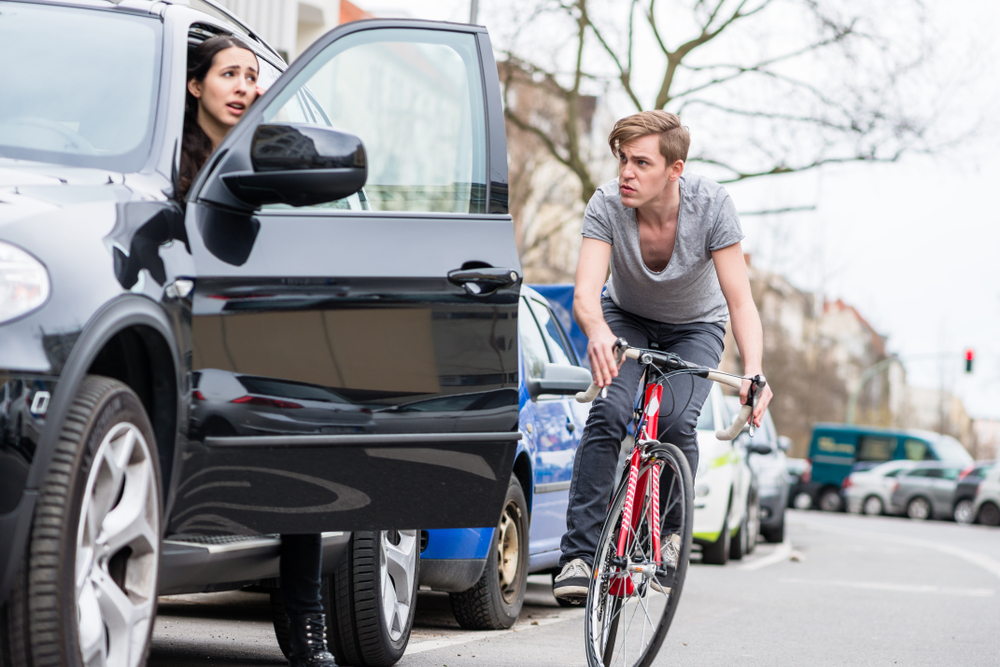

You're riding your bicycle along Main Street in Hackensack, maybe heading home from Riverside Square or cutting through downtown toward Anderson Street. A parked car sits ahead in the bike lane, and before you can react, the driver's door swings wide open directly into your path. The collision is sudden, violent, and entirely preventable. This type of crash is known as "dooring," and if it has happened to you, the person who opened that car door is very likely the one responsible for your injuries.
Here is something that surprises many New Jersey cyclists: unlike most other states, New Jersey does not currently have a specific anti-dooring traffic statute on the books. But that does not mean you are without legal protections. Under New Jersey's well-established negligence laws, the person who carelessly opened their car door into your path can absolutely be held liable for your medical bills, lost wages, and pain and suffering. The legal framework is strong, and understanding how it works can make all the difference in your recovery.
Key Takeaways about Who is Liable In a Dooring Bicycle Accident
- "Dooring" happens when a driver or passenger opens a car door into the path of an oncoming cyclist, causing a collision.
- New Jersey does not have a dedicated dooring statute, but injured cyclists may still pursue compensation through general negligence claims.
- The person who opened the car door typically bears the primary liability, though passengers, rideshare drivers, and even municipalities may share fault in certain cases.
- New Jersey's modified comparative negligence rule allows an injured cyclist to recover damages as long as they are found to be no more than 50% at fault.
- Injured cyclists have two years from the date of the accident to file a personal injury lawsuit.
What Is a Dooring Accident?
A dooring accident occurs when someone inside a parked or stopped vehicle opens their door into the path of an approaching cyclist. The cyclist either strikes the door directly or swerves to avoid it and collides with another vehicle, a curb, or a fixed object. Either way, the injuries can be severe.
These crashes tend to happen in predictable situations:
- Curbside parking next to a bike lane. A driver finishes parking along a busy street like River Street or Essex Street in Hackensack and opens their door without checking for approaching cyclists in the adjacent lane.
- Passenger exits on the traffic side. A backseat passenger in a rideshare vehicle steps out into the roadway without looking.
- Double-parked vehicles. A delivery driver or motorist stopped temporarily in the travel lane opens their door while a cyclist passes on the left.
Because cyclists have very little physical protection, even a seemingly low-speed collision with a car door can result in broken bones, traumatic brain injuries, spinal cord damage, severe road rash, and dislocated shoulders. In the worst cases, a cyclist thrown from their bike may land in the path of moving traffic, turning an already serious accident into a life-threatening one.
Why Doesn't New Jersey Have a Dooring Law?
Most states across the country have adopted traffic statutes that specifically prohibit vehicle occupants from opening a car door unless it is safe to do so and will not interfere with moving traffic. These laws create a clear, codified duty of care and make it straightforward to assign fault in dooring cases.
New Jersey, however, has not passed such a statute. A legislative proposal was introduced back in 2015 to address the issue, but it never made it through the legislature. As a result, there is no specific traffic violation for dooring in New Jersey's motor vehicle code.
But here is the important part: the absence of a specific dooring law does not leave cyclists unprotected. New Jersey's civil negligence framework provides a strong legal path for injured riders to seek compensation.
Every person in New Jersey has a general duty to act as a reasonably prudent person under the circumstances. Opening a car door into a lane of traffic or a bike lane without first checking for approaching cyclists falls well short of that standard.
In practice, courts have consistently recognized that swinging a car door open without looking is negligent behavior, plain and simple. The lack of a specific statute does not weaken your claim. It simply means your bicycle accident attorney will build the case under established negligence principles rather than citing a single traffic violation.
Who Can Be Held Liable in a Dooring Accident?
Liability in a dooring crash is not always limited to one person. Depending on the circumstances, several parties may share responsibility for your injuries.
- The person who opened the door. This is the most straightforward case. Whether it is the driver or a passenger, the individual who opened the door without checking for oncoming traffic is typically the primary at-fault party. They had direct knowledge that they were about to open the door and had every opportunity to check their mirrors and look over their shoulder before doing so.
- The driver of the vehicle (even if a passenger opened the door). In some situations, the driver may share liability. For example, if the driver pulled over in a location that made it dangerous for passengers to exit, such as alongside a busy bike lane or in a no-stopping zone, their decision to stop there may contribute to the accident.
- Rideshare companies and their drivers. Dooring accidents involving Uber and Lyft vehicles have become more common as rideshare use has grown. Passengers unfamiliar with their surroundings may exit on the traffic side without looking. The rideshare driver may share fault for stopping in an unsafe location or failing to instruct the passenger to exit curbside.
- Municipalities or government entities. If a poorly designed or maintained bike lane contributed to the accident, such as a lane that abruptly ends or places cyclists dangerously close to parked cars, the municipality responsible for road design may bear some liability. Claims against government entities carry additional requirements, including a 90-day notice of claim filing deadline.
Each case is different, and determining where fault lies often requires a thorough investigation of the accident scene, witness accounts, and available video or photo evidence.
How New Jersey's Comparative Negligence Rule Applies
New Jersey follows a modified comparative negligence system under N.J.S.A. 2A:15-5.1. This means that more than one party can share fault for an accident, and your compensation will be reduced by whatever percentage of fault is assigned to you.
Here is how it works in a dooring scenario. Suppose a jury determines that the driver who opened the door was 80% at fault for the crash, but you were 20% at fault because you were riding outside the bike lane. If your total damages were $100,000, your recovery would be reduced by 20%, resulting in a $80,000 award.
The critical threshold to know is 51%. If you, as the injured cyclist, are found to be 51% or more at fault for the accident, you cannot recover any damages at all. This is why insurance companies in dooring cases often try to argue that the cyclist was riding too fast, not paying attention, or traveling outside the bike lane. Having strong evidence that supports your version of events is essential to preventing the other side from shifting blame onto you.
Common arguments insurance adjusters may try to use against an injured cyclist include:
- The cyclist was not wearing reflective clothing or using lights.
- The cyclist was riding against traffic or outside the designated lane.
- The cyclist was distracted by a phone or headphones.
- The cyclist had enough time to stop or avoid the door.
An experienced Hackensack bicycle accident lawyer can counter these arguments with physical evidence, witness testimony, accident reconstruction analysis, and a thorough understanding of New Jersey cycling laws.
The Two-Year Filing Deadline You Cannot Afford to Miss
Under N.J.S.A. 2A:14-2, New Jersey gives injury victims two years from the date of the accident to file a personal injury lawsuit. If you miss this deadline, you generally lose the right to pursue compensation entirely, no matter how strong your case may be.
Two years may sound like plenty of time, but building a solid dooring case takes work. Evidence needs to be gathered, medical treatment needs to be documented, and negotiations with insurance companies can drag on for months.
Starting the process early gives you the best chance of a favorable outcome. If your accident involves a government entity, such as a claim related to a poorly designed bike lane on a public road, you may need to file a notice of claim within just 90 days.
What Compensation Can You Recover After a Dooring Accident?
If you have been injured in a dooring crash and can prove that another party's negligence caused your injuries, you may be entitled to recover several types of damages:
- Medical expenses. This includes emergency room visits, hospital stays, surgeries, physical therapy, prescription medications, and any ongoing or future medical care related to your injuries.
- Lost wages. If your injuries forced you to miss work, you can seek compensation for the income you lost during your recovery. If your injuries affect your ability to work in the future, lost earning capacity may also be part of your claim.
- Pain and suffering. Physical pain, emotional distress, anxiety, depression, and loss of enjoyment of life are all compensable under New Jersey law.
- Property damage. The cost to repair or replace your bicycle, helmet, clothing, and any other personal property damaged in the crash.
The value of your claim will depend on the severity of your injuries, the strength of the evidence, and the insurance coverage available. Every case is unique, and a thorough evaluation by a qualified attorney is the best way to understand what your claim may be worth.
FAQs for Dooring Accidents in Hackensack
Here are some of the most common questions cyclists ask about dooring accidents and their legal rights in New Jersey.
Can a passenger be held liable if they open a car door into a cyclist?
Yes. Liability in a dooring case applies to whoever opened the door, whether that person is the driver or a passenger. The duty to check for approaching traffic before opening a vehicle door applies equally to everyone inside the vehicle.
What if the dooring accident happened in a parking lot instead of a public road?
You may still have a claim. Negligence principles apply on both public roads and private property like parking lots and shopping center garages. The key question remains whether the person who opened the door acted with reasonable care.
Does it matter if I was not riding in a designated bike lane when I was doored?
Not necessarily. Cyclists in New Jersey have the legal right to use public roadways, and riding outside a bike lane does not automatically make you at fault. However, your lane position may be one factor considered when determining comparative negligence.
Can I still recover compensation if I was not wearing a helmet at the time of the accident?
New Jersey does not require adult cyclists to wear helmets, so the absence of a helmet generally cannot be used to deny your claim. However, if a helmet could have reduced the severity of a head injury, the defense may argue it should factor into the damages calculation.
What happens if the person who doored me drove away, or I could not identify them?
If the at-fault party cannot be identified, you may still have options through your own uninsured motorist coverage, depending on the terms of your auto insurance policy. An attorney can review your coverage to determine what benefits may be available.
How long does a dooring injury case typically take to resolve?
Every case is different. Some claims settle within a few months through insurance negotiations, while others may take a year or more if a lawsuit is necessary. Factors like the severity of your injuries, the complexity of liability, and the willingness of the insurance company to negotiate in good faith all play a role.
Should I accept the insurance company's first settlement offer after a dooring accident?
It is generally wise to consult with an attorney before accepting any offer. Initial settlement offers from insurance companies are often far lower than the actual value of your claim and may not account for future medical expenses or the full extent of your pain and suffering.
Talk to a Hackensack Bicycle Accident Attorney Today
If a car door caused your bicycle accident on the streets of Hackensack or anywhere in Bergen County, you deserve answers and you deserve fair compensation. Dooring injuries can change the course of your life, and the legal process does not have to add to your stress.
At Reinartz Law Firm, we take the time to understand every detail of what happened, build the strongest possible case on your behalf, and fight to hold the responsible parties accountable. Consultations are free, and you pay nothing unless we recover compensation for you. Call us today or book your free consultation online to take the first step toward getting your life back on track.